I spent some time researching and mapping how a16z and Y Combinator publish. Not their investments, but their media operations. What do they produce, where is it published, how is it shaped into different formats, and how does it continue circulating for weeks?
What I found was that neither firm had taken the ordinary route of hiring an agency and handing over its media operation. They had built their own operating systems.
Any large fund can invest money in startups. What no fund can simply transfer is attention, trust, and ownership of a category. a16z and YC understood this early, then built their systems in completely different directions. One broadcasts and the other teaches.
Capital Is No Longer Just About Money & Trust
This is not a new idea. Firms with financial capital place their trust in people based on past experience or the opportunities they see in them. That means those people already hold a form of trust capital. But what I am talking about here goes beyond trust. It includes a media and distribution network, reputation, attention, and other forms of capital.
Today, if all you do is provide money and offer nothing more to improve the company's position, you are probably a fairly ordinary venture capital firm. A founder may see you as replaceable and may not trust you enough to choose you.
Start with the why, because it's the whole point.
Money alone no longer makes an investment fund stand out. If you have built a strong company, several funds of a similar size may be able to offer you the same amount of capital. In that situation, founders do not look only at the money. They look at which fund understands them better, earns their trust from the beginning, and genuinely understands the space their company operates in. That is why funds try to build an advantage beyond capital.
They want:
- Founders to come to them first,
- To create trust before the first meeting,
- To shape how the category they invest in is understood and discussed.
Media produces all three. A steady stream of theses and reports makes founders think "these people understand this space better than anyone," so they show up before anyone else sees the deal. Years of the same message make a founder walk into the first meeting already sold. Launch videos turn a portfolio company into a customer magnet and a hiring magnet.
That is the main idea. Media is not just a marketing tool here. It helps these firms attract better opportunities, earn trust, bring talent to their portfolio companies, and shape how people think about an industry. The rest is simply about how a16z and YC run that system in their own way.
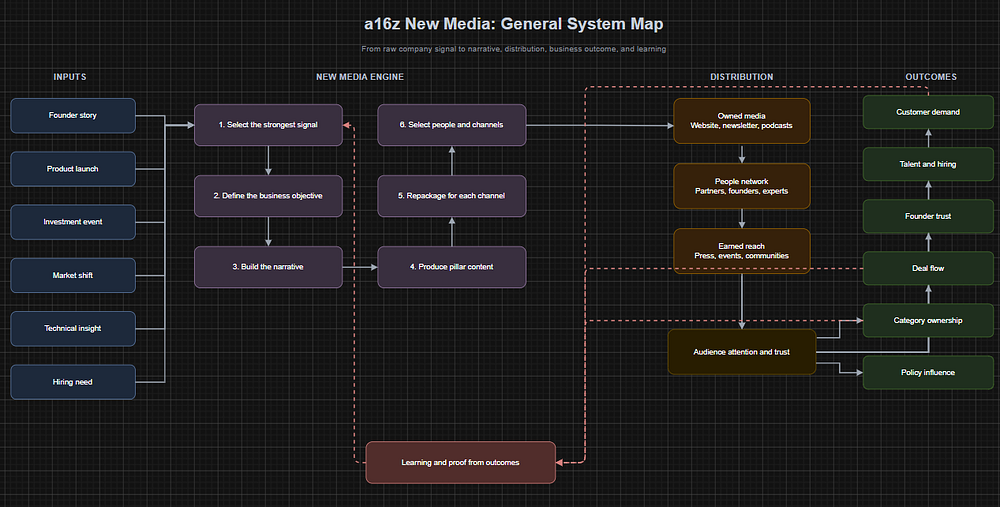
a16z New Media General Map
a16z: The Broadcast Engine
a16z runs a media company that operates every day inside an investment fund. According to the figures it has shared, it has around one million followers on X, a daily newsletter with roughly 250,000 subscribers, and a podcast network that publishes five days a week. What matters most here is not the scale, but how the system is built.
The idea that stayed with me the most was their "go direct" approach. The main difference between old media and new media is who controls the narrative.
In old media, you do not decide the final form of your own words. You say something and explain yourself, but your words are selected, shortened, and placed into a different frame by other people. Even when your intention is clear, the story that comes out may not be the story you built. You do not control the distribution channel, the context, or the final form of the narrative. This can lead to misunderstandings, reputational risk, or problems that were never necessary.
In new media, you reduce the number of people standing between you and the world when sharing your ideas, and you reach people directly. The core of the go direct approach is sharing your thoughts in your own words and through your own channel while preserving as much context as possible. Connected to this point, I think the other most important idea is that people matter more than companies here. People communicate through their own names, ideas, expertise, and personalities rather than through a company logo.
The word "own" is important here. Social media is like rented space. If the algorithm changes, you may lose your reach. Your website and newsletter, however, belong to you. A newsletter sent five times a week and a permanent content archive form the foundation of a distribution line that no one can shut down.
New media is not only about producing different content formats. How the content is packaged, divided into different formats, distributed, and delivered to the people who need to see it is also part of the same system.
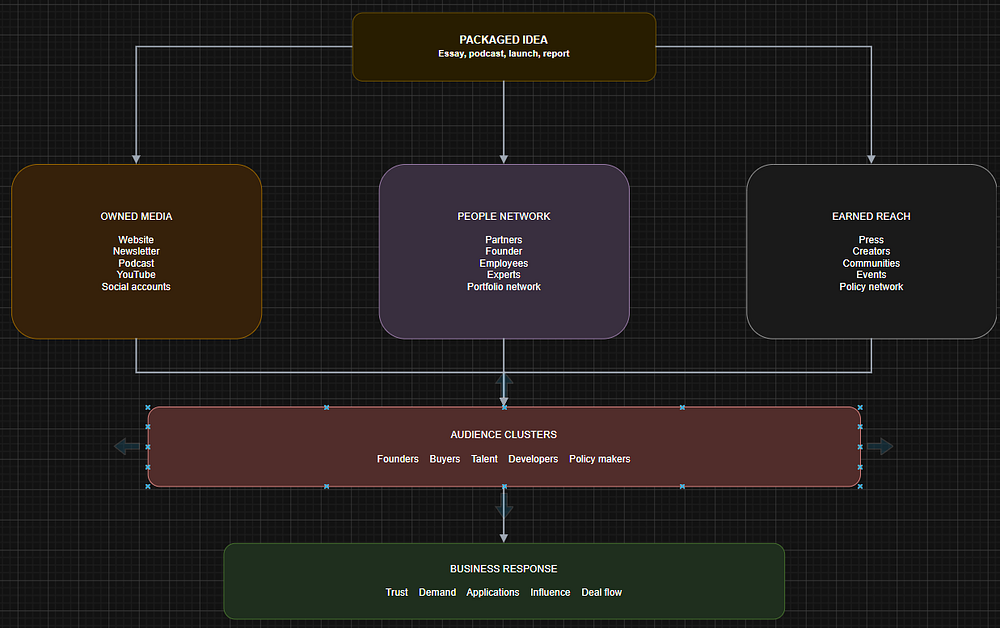
a16z Distribution Overview
"New Media" as we practice it isn't really a type of content; it's a type of packaging that's designed to help you be interesting. For example, it might mean:
- The "longform conversation / essay + short form clips" barbell, or other formats designed to highlight compelling ideas with messy context rather than crisp on-message
- Guerilla-style amplification, like mastering the QT format to get an essay the algorithmic traction it needs to break through: doing whatever it takes to deliver the longform idea to the select audience that should hear it
- A well-crafted press campaign that can get you a media spot because you don't need it, but they want you anyway
Source: New Media, One Year In
A long conversation or essay carries the main idea and its context, while short clips, quote posts, and other short formats take on the job of distribution. The aim is not to simplify every idea by turning it into something clean, corporate, and built around a single message, but to preserve interesting ideas within their messy context and package them well. The format, the packaging, the reach created through algorithms, and the press work are all parts of the same system as the content itself.
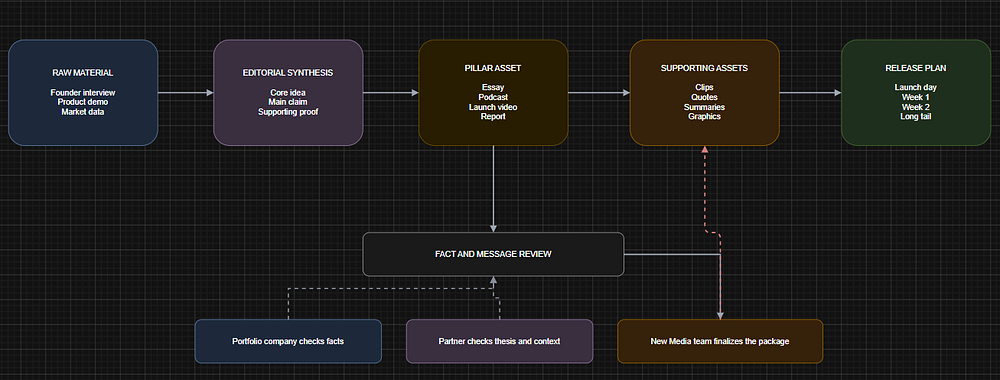
a16z Content Production Flow
In practice, the system starts with a substantial core piece of content, such as a podcast, article, launch video, or investment announcement, and turns it into shorter formats suited to the structure of each channel. Over time, a long conversation can become short clips, social media posts, newsletter content, and press work. This allows the same core idea to keep circulating across different channels.
The same idea appears on X as a series of arguments, on LinkedIn as educational content, in the newsletter as a deeper narrative, and becomes permanent on the website.
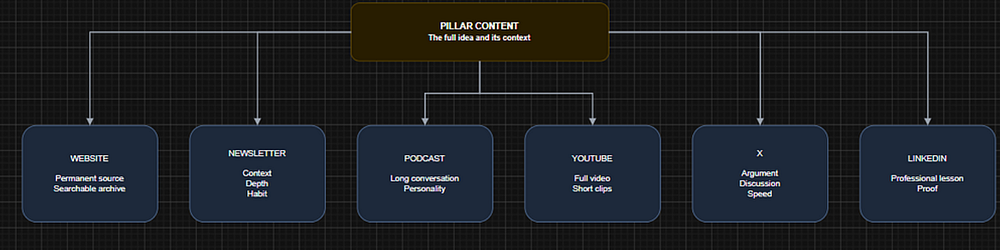
a16z Channel Packaging Map
Two details make this system stronger over time.
Partners are not just people, but also distribution channels. The firm account may share the content first. Then partners, founders, and other trusted people spread the same idea through their own accounts, each adding a different perspective.
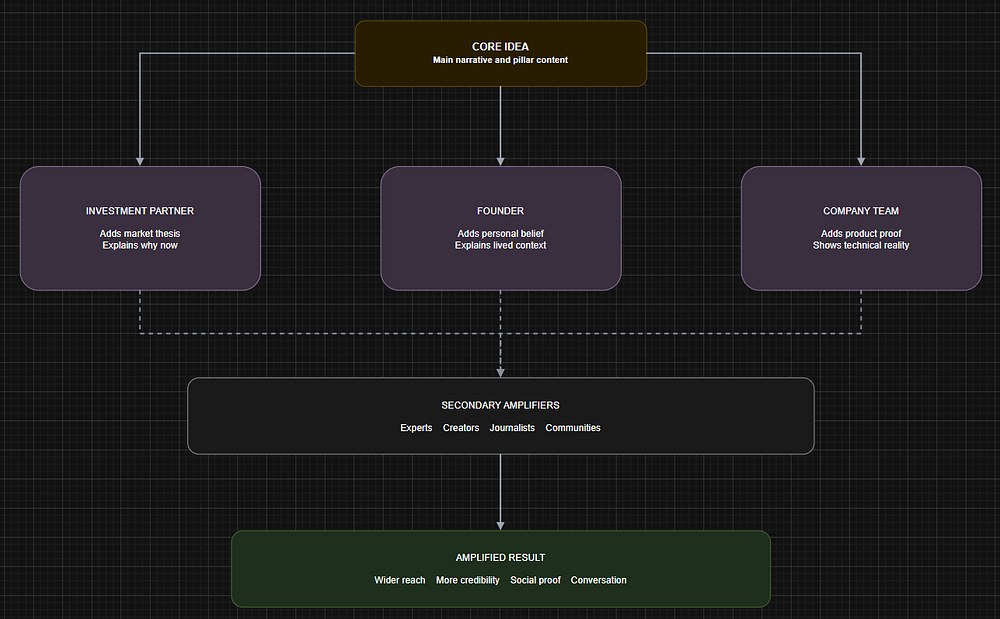
a16z People Amplification Flow
Many of a16z's strongest investment announcements read more like market theses than investment news. The text does not begin with "we invested in this company." It first presents a problem, answers the question "why now," defines a new category, and only then positions the company as the player filling that gap. The announcement is more than ordinary news. It is a short argument about where the world is heading, and the company is the proof of that argument.
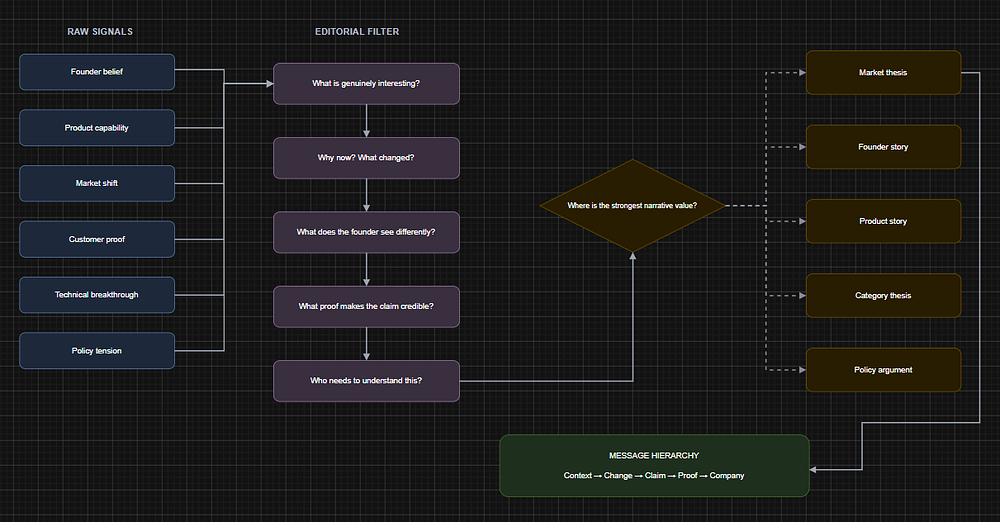
a16z Signal and Narrative Flow
This is also why a16z can name categories such as American Dynamism and Little Tech and shape the conversation around those areas. Once you give a space a name, everyone building in it starts to think about and describe it through the frame you created.
YC: The School That Is a Funnel
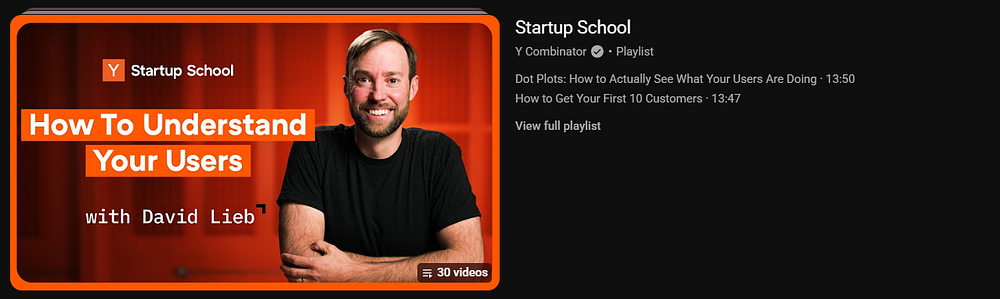
YC Startup School
YC shares a broad body of startup-building education with everyone, for free and in plain language. The core of this advice has barely changed in about 20 years. The motto "make something people want" has remained central to YC's approach since its early years. Its main advice still revolves around launching something, talking to users, and building the product they truly want.
Its reach is huge, and instead of pushing content toward people, this system helps people discover YC on their own. It has a YouTube channel with more than two million subscribers, the free Startup School program, and Hacker News, which has been running since 2007. Even when YC itself does not post anything, Hacker News keeps the brand in front of developers every day. The Requests for Startups list tells founders which areas YC wants to see companies built in and indirectly shapes the kinds of ideas that arrive in the next batch.
All of these channels create different paths that eventually lead to the same outcome. A founder builds something people want and decides to apply to YC.
A founder runs into a problem, searches online, finds a YC advice video, watches its content library, reads the Requests for Startups list, and applies. YC runs four batches a year, and each batch includes a large number of startups. Companies become visible through the YC Startup Directory and Launch YC. Some also attract attention through Hacker News. Toward the end of the program, Demo Day puts the companies in front of invited investors and media representatives. The company then joins the alumni network and helps new founders discover YC. Their stories become new content, and the system keeps feeding itself.
What makes YC different from a16z is that its strength comes from teaching founders how to build a startup before the company has fully taken shape.
The Difference
Both are media operating systems. However, they work in different directions for completely different purposes.
a16z continuously communicates a particular worldview to founders, talent, and decision-makers in Washington. It keeps doing this until the category becomes visible enough and the relevant people start coming to a16z on their own.
YC, on the other hand, builds an education-centered system that is strengthened by its community and grows over time through its alumni network. It keeps teaching founders, and the trust it creates gradually turns into applications.
What a Small Team Can Copy
The mechanics behind these two systems require discipline more than a large budget.
Define the Category Before You Create Content
Do not publish inside a frame built by someone else. First define the space and your main claim. What problem do you want to solve in the world, and why should you be the one to solve it? Then let everything you produce strengthen that idea.
Make the Media Free and Generous by Earning Your Revenue Somewhere Else
Both institutions make money from their equity investments, not from content. This separation allows them to offer their content freely and openly. YC also uses education to attract and develop founders who may apply in the future. Neither charges for the content, which gives the content room to be genuinely useful. Define what you actually sell, then offer the media for free.
Put a Person in Front and Let the System Run Behind Them
People trust people, not logos. Let a person be the visible face of the content, but base the production process on a repeatable system.
One Idea, Many Channels, One Shared Language
Instead of writing ten different ideas once, tell one idea in ten different ways. It can become a thread, post, clip, newsletter, or talk. What makes an idea yours is adapting it to different channel networks and putting it into circulation.
Treat Publishing Cadence as an Operational Problem, Not a Matter of Inspiration
Publishing five times a week is not a creative miracle. It is a well-built production line. Once you design the process, production no longer depends on how you feel that morning.
Own a Channel That the Algorithm Cannot Take Away From You and That People Return to Regularly
This could be a newsletter, website, or content archive. Social media is the shop window, while the channel you own is the shop itself.
The Content Is the Cheap Part
Plenty of people and companies create strong articles, videos, and podcasts without getting any real results from them.
What makes these two firms different is that they use content as part of a larger system. Their content attracts attention, builds trust, and eventually brings the right founders to them. a16z does this through market theses and a powerful distribution network, while YC builds relationships with founders through free education, often before those companies even exist.
Anyone can create content. The hard part is building a media operating system that decides which ideas to produce, how to package them, who should distribute them, and which business outcome they should lead to. That is where the real advantage of a16z and YC lies.